Congratulations to Xue for taking home the award for best student talk entitled “Quantitative solvent selection toolkits for functional materials preparation” in the Theory Guided Discovery of Energy Materials symposium at CSC2023.
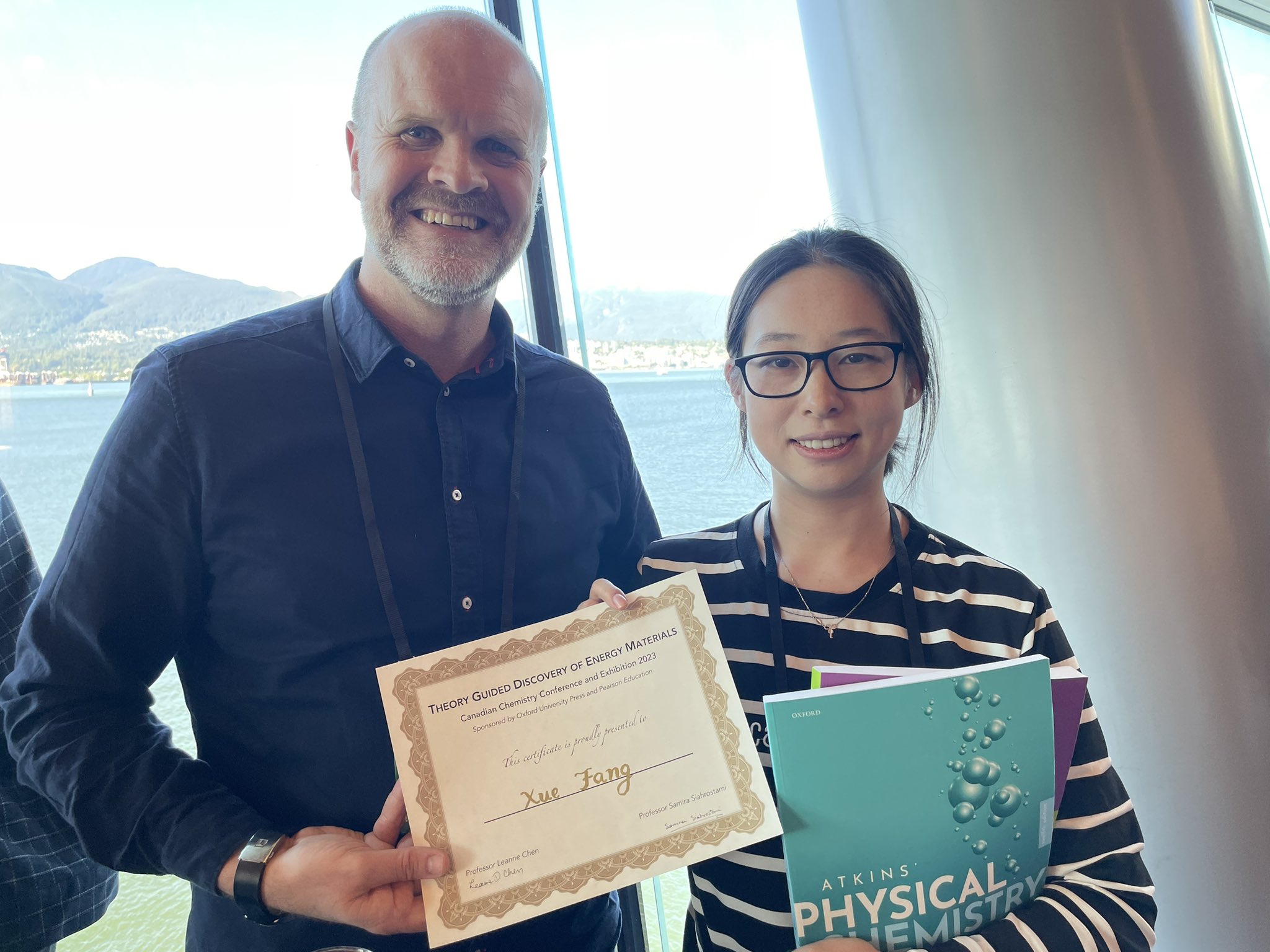
Congratulations to Xue for taking home the award for best student talk entitled “Quantitative solvent selection toolkits for functional materials preparation” in the Theory Guided Discovery of Energy Materials symposium at CSC2023.
Yubing joins the Faul Group as a visiting student from Xi’an Jiaotong University, China for a year. Her research focus is on the design and applications of conjugated microporous polymers and their application in the removal of heavy metal ion pollution in wastewater. Welcome!
Excited to announce Basiram and Dr. Baker‘s latest openly accessible article in Adv. Mater. entitled “Selective CO2 electroreduction from tuneable naphthalene-based porous polyimide networks” detailing exciting new metal-free materials for CO2 capture & reduction.

The Faul Group is inviting potential candidates to contact Professor Faul with two letters of reference and a CV to explore the application for a Newton International Fellowship.
Please check the link above for details and eligibility criteria.
Deadline: 28th March 2023.

Congratulations from all of the Faul Group to Nouf Zaghloul who passed her PhD viva on 26th January. Her research featured novel contributions to science concerning scribe-on: writing wearable, flexible and stretchable electronics with polyaniline.
She leaves the group to continue in scientific research at the University of Bath. Best of luck.
Thank you to Dr Shirin Alexander of Swansea University for her time in the process.
A quick post to invite any eligible Chinese students to apply for the China Scholarship Council – University of Bristol joint-funded PhD Scholarship.
The China Scholarship Council (CSC)/University of Bristol joint-funded scholarships programme offers 60 fully funded PhD scholarships for up to 48 months of research at the University of Bristol.
More details on eligibility and how to apply can be found here.
Any questions should be directed at: bristol-csc@bristol.ac.uk
In order to be eligible for consideration for a CSC-University of Bristol PhD Scholarship, you must submit your completed application for your PhD programme by midday (UK time) on Thursday 1 December 2022.
Slightly late welcome to the Faul Group’s newest undergraduate starters this year.

From left to right: Miles (working with CMPs for waste water treatment), Julia (soft actuation), Anna (metallo-supramolecular polymer assembly) and Lewis (adhesives for soft actuation).
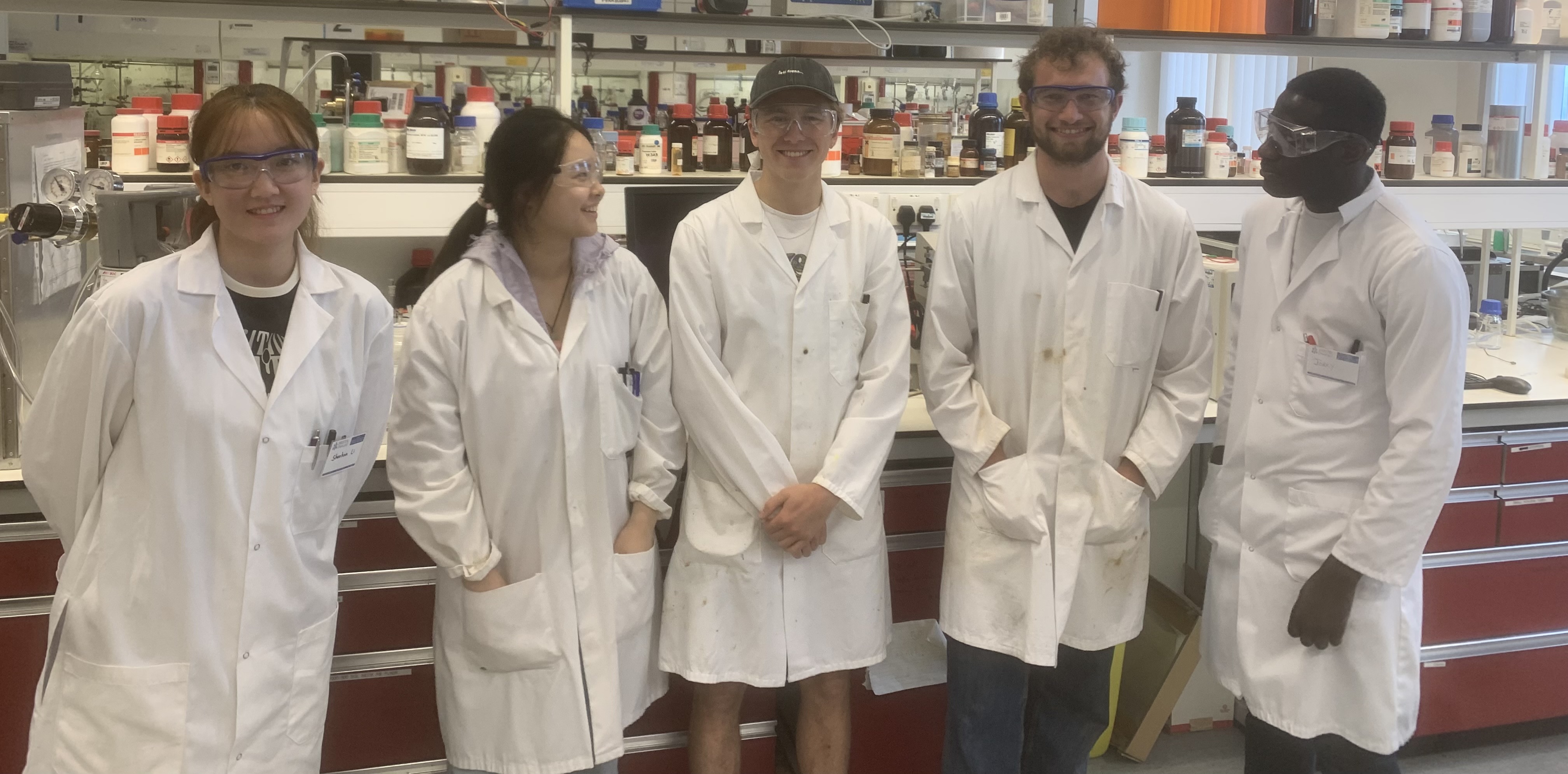
Pleased to welcome (from left to right) Shaohua (perylene diimide self-assembling materials), Ziqiu, Leo (biocompatible polymeric actuators), Daniel (conjugated microporous materials for antibacterial applications) and Jerry (perylene-based polyimide networks for CO2 capture and conversion).
Shaohua, Ziqiu, Leo and Jerry are Bristol undergraduates joining the group for summer projects and Daniel joins to complete his MSc associated with the Bristol Centre for Functional Nanomaterials.
Interested in multidisciplinary MRes project relating to soft robotics, smart structures, polymer chemistry and healthcare? Announcing an exciting opportunity linked to emPOWER Transformative Healthcare Technologies – a UKRI-EPSRC funded research programme focusing on in-body artificial muscles for physical augmentation, function restoration, patient empowerment & future healthcare.
Currently accepting applications from both UK and international students. Please contact Prof Charl Faul or Dr Ben Baker with a short cover letter for more details.

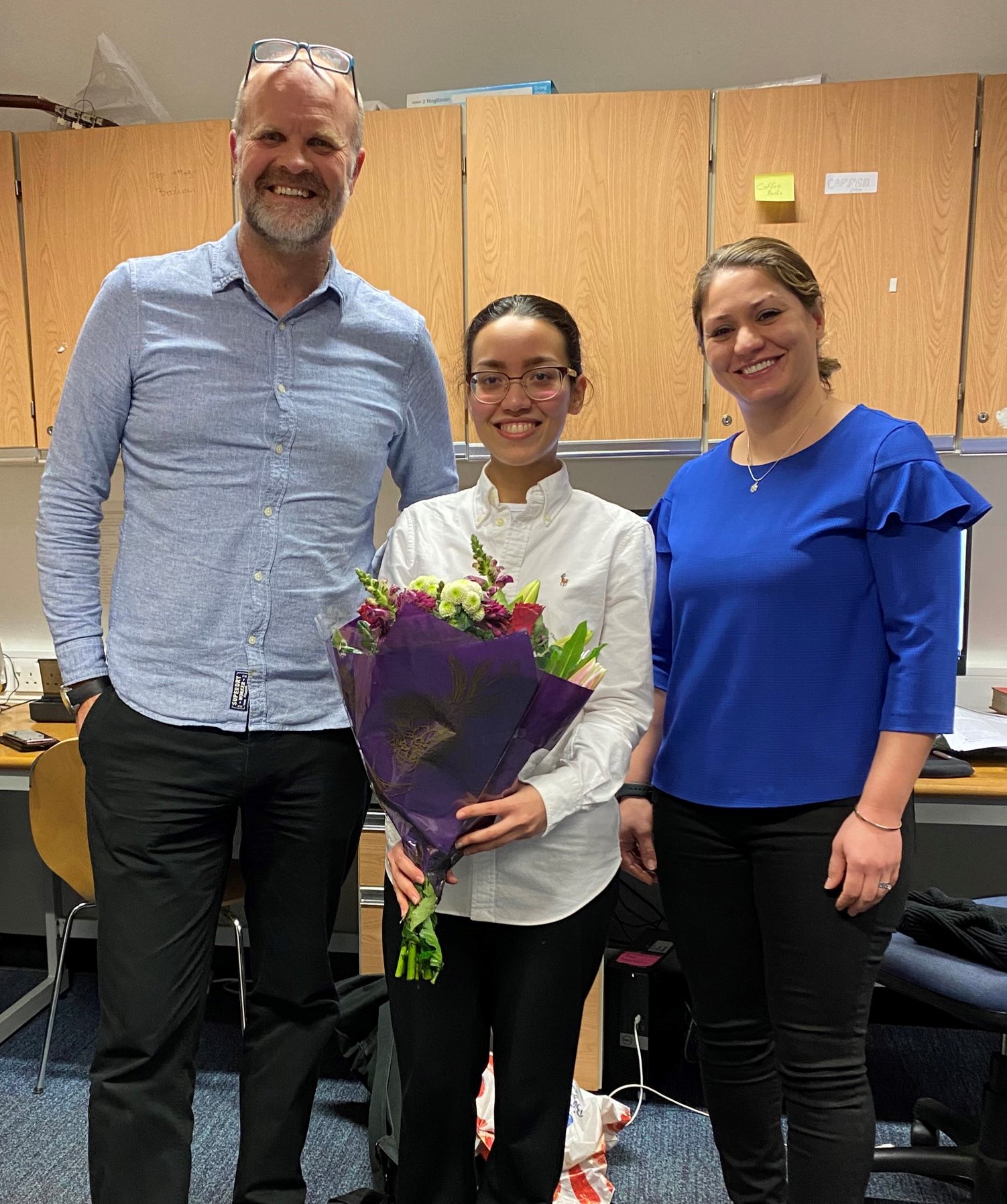
Many congratulations to Dr Veronica Del Angel Hernandez who passed her PhD viva last week. We wish her continued success in her postdoctoral research associate position within the Cooper Group at the University of Liverpool.
Further celebrations are in order for group members Neha Yadav and Basiram Narzary. Both are both recipients of prizes at last week’s GWPore conference for contributing with a talk on polymer formation using cyclic carbonates from CO2 and a poster discussing CO2 capture and conversion using microporous materials (see below), respectively.


