Here we report on a one-pot scalable synthesis method using autoclaves to produce conjugated microporous polymers (CMPs) with enhanced surface area and exceptional adsorption capabilities for CO2 and heavy metal ions. With degas-free and facile scale-up opportunities, this method opens real possibilities for wide industrial applications of CMPs.
Electrorheological fluids (ER) make up a class of smart materials that are distinguished by their capacity to alter their rheological characteristics in a controlled and reversible manner in response to an externally applied electric field (E). Three-dimensional (3D) conjugated microporous polymer (CMP) analogs of PAni have a nitrogen-rich porous and hierarchical structure, low density, and appropriate conductivity that can be used to explore ER performance and dispersion stability. Here, a carboxylic acid functionalized version was designed to obtain higher polarizability and appropriate conductivity without the need for a dedoping process and thus enhanced ER performance.
A recent paper titled “Electrorheological Fluids Based on Porous Carboxyl-Functionalized Polytriphenylamines” authored by both Ulzhalgas Karatayeva and former postdoc Dr Ozlem Erol (now assistant professor at Gazi University, Ankara, Türkiye), and Charl Faul has been accepted for publication in ACS Appl. Polym. Mater.
Further information and more details to follow soon!
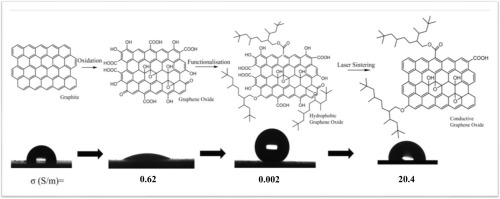
Maxi’s work on a series of dopamine-based polymers and introduced as non-cytotoxic, single-component bio-adhesives that outperform commercial options features on the front cover of Macromol. Rapid Commun. See article 2400345 for more details.
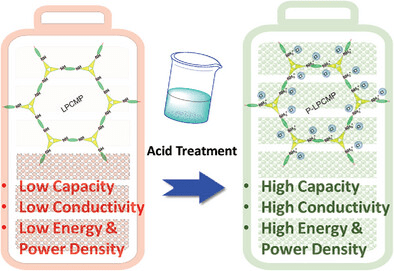
Here, a novel triphenylamine-based porous polymer (LPCMP) is presented as an outstanding lithium-ion battery cathode, delivering 146 mAh g-1 at 3.6 V, high power density, and stability over 1000 cycles, marking a breakthrough for high-energy organic LIBs. These exciting results stem from the close collaboration with colleagues from the National Centre for Nanoscience and Technology, Chinese Academy of Sciences, Beijing.
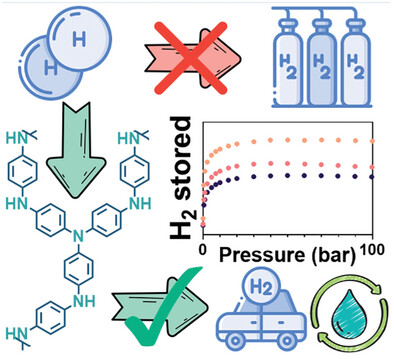
A recent paper titled “Polytriphenylamine Conjugated Microporous Polymers as Versatile Platforms for Tunable Hydrogen Storage” authored by John Worth and co-authored by Profs. Annela Seddon, Valeska Ting, and Charl Faul has been accepted for publication in Small by Wiley.
This work explores the use of polytriphenylamine-based conjugated microporous polymers (CMPs) for advanced hydrogen storage applications.
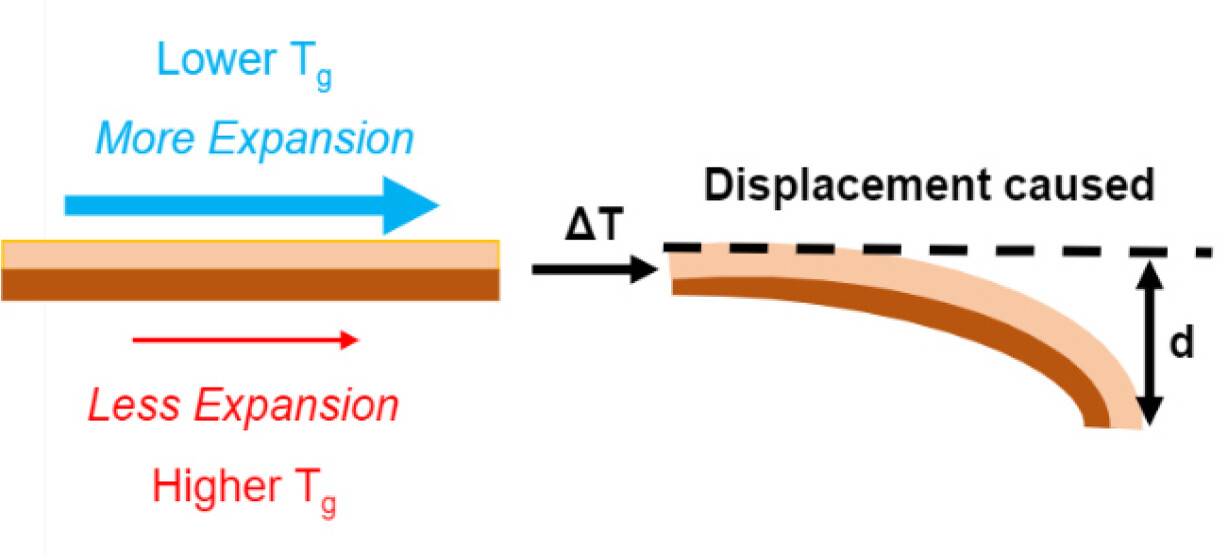
The development of soft, biocompatible actuators is vital for soft robotics, especially for in vivo applications. This study presents epoxy-based materials for creating thermal actuators with tuneable glass transition temperatures (Tgs). By adjusting polymer compositions, actuators operating at physiological temperatures (36–40 °C) were achieved using both external heating and joule-heated NiChrome-epoxy systems. These actuators maintain safe surface temperatures below 40 °C at low voltages (<2 V). This promising approach could lead to implantable actuators improving the quality of life for the ageing population.
Efficiently treating wastewater contaminated with carcinogenic hexavalent chromium (Cr(VI)) has been a persistent challenge in both academic and industrial research. While ion exchange is recognised for its simplicity and effectiveness, its integration with advanced nanomaterials offers enhanced potential. The cationic porous organic polymer (POP) PTPA–PIP is a novel development poised to aid in industrial wastewater treatment.
PTPA–PIP is synthesised by converting the aromatic polyamine PTPA into its protonated form. This modification significantly increases the polymer’s hydrophilicity, enabling it to disperse uniformly in aqueous environments, which is essential for efficient water treatment applications. PTPA–PIP demonstrates the following:
High exchange capacity: PTPA–PIP exhibits a maximum adsorption capacity of 230 mg Cr2O72– per gram of polymer.
Rapid adsorption kinetics: It achieves an initial adsorption rate of 83 mg g–1 min–1, indicating ultrafast removal of contaminants.
Exceptional Selectivity: The polymer retains approximately 90% of its adsorption capacity even in the presence of a 40-fold concentration of competing anions.
Robust reusability: PTPA–PIP can be reused for at least five cycles without significant loss of performance.
This publication documents a substantial advancement in the field of wastewater treatment with porous polymers, offering a highly effective solution for addressing the challenges associated with Cr(VI) contamination.