This is the official website for the Faul Research Group, based in the School of Chemistry, University of Bristol, Bristol, UK. Follow us on LinkedIn: https://www.linkedin.com/in/charl-fj-faul-付强/
This week, the Faul Group is welcoming back Ulia as she returns from her two-month visit to the National Institute for Materials Science, Tsukuba, Ibaraki, Japan. During this collaborative period, her skills concerning in situ measurements for evaluating material performance in carbon dioxide reduction were honed.
Pleased to announce that Faul Group member Sam Deeks, Prof Faul and Dr Lennox have co-founded Mixterial.
Sam and co-founders have developed an innovative range of conductive composites suitable for use in electrosynthesis, aerospace, sensors, and various other applications. The materials and technology were developed and refined during Deeks’ PhD and proved to be commercially viable.
Funding for market research and viability assessment was made possible with the Innovate UK ICURe EXPLORE initiative – a comprehensive 12-week market exploration program. It offers financial backing of up to £35,000 to cover the Entrepreneurial Lead’s salary, assumption testing, and customer discovery endeavours. Its primary objective is to assist research teams from various regions of the UK in exploring technology applications and validating value propositions through extensive global market engagement.
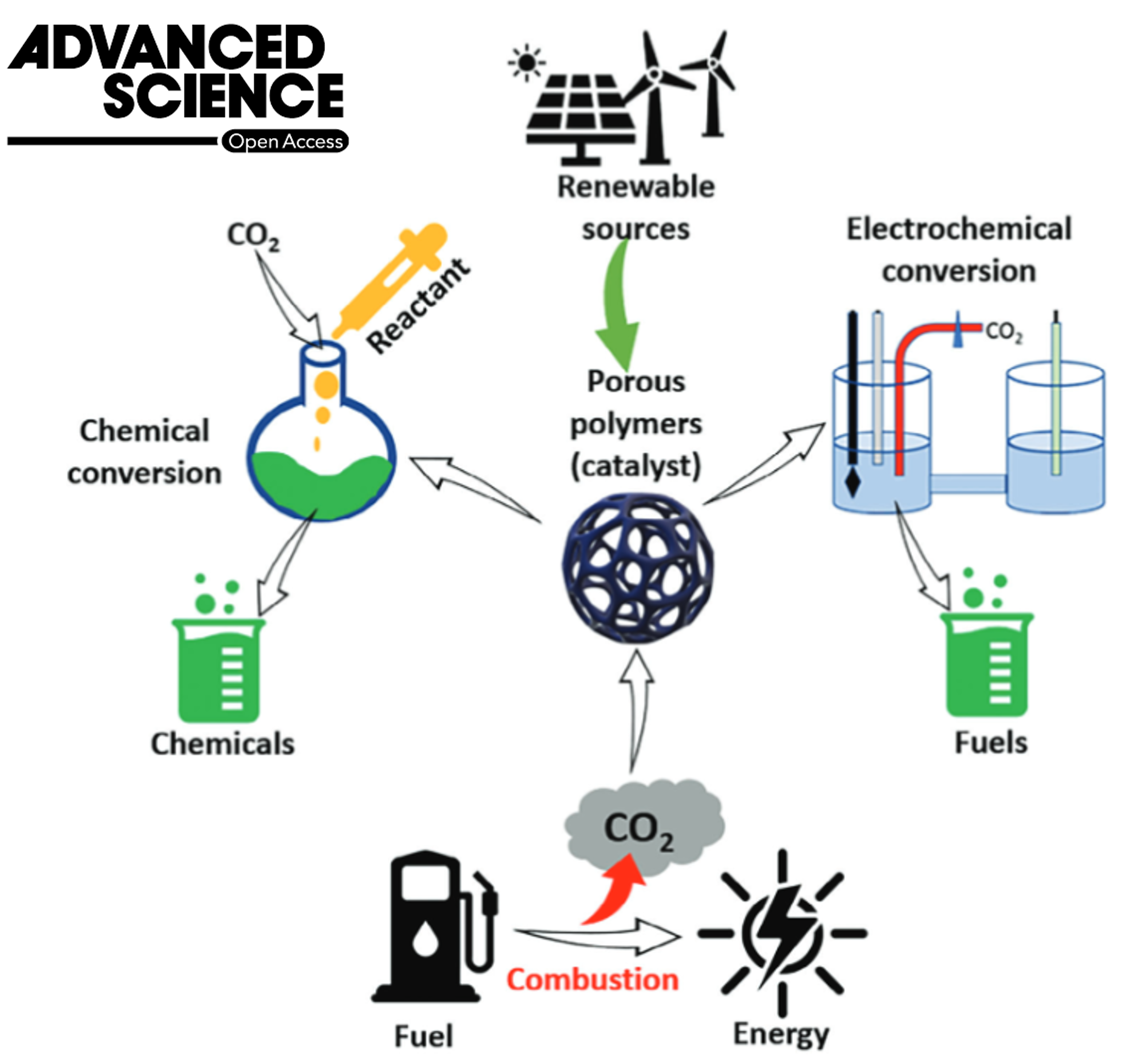
The first publication of 2024 from the Faul Research Group, primary authored by Ulzhalgas, is an open access review covering studies demonstrating how desirable properties possessed by conjugated microporous polymers (CMPs) offer a route to sustainable and green long-term solutions.
Researchers and experts (including Prof Faul and Dr Baker) from the University of Bristol have developed a new technology known as PoreSafe. These materials offer innovative solutions to tackle bacterial growth, even for the most resilient bacteria. Additionally, the activity of these materials does not diminish over time and can be blended and incorporated into other materials and formulations.
A short video introducing this technology can be found below.
Jerry Mintah, a Royce Summer Intern, shares his experience of working with the Faul Research Group in an interview with Dr. George Miller, the Royce Student Engagement Manager. During the eight-week internship, Jerry worked alongside his mentor, Basiram Brahma Narzary, and supervisor, Professor Charl F. J. Faul.
Jerry’s Royce Summer Internship project was focused on porous polyimide networks for CO2 capture and conversion. The project has the potential to significantly contribute to industrial decarbonisation and combat the urgent climate crisis brought about by global warming.
Jerry was also co-author on a recent paper from the Faul Group, which was featured on the inside front cover of the RSC journal Materials Chemistry Frontiers.
More information can be found at Royce.ac.uk and the complete interview is available below.
The conference aims to provide an international platform to discuss emerging trends and advancement in the research and development of various classes of materials and is divided into four major themes: (i) Future Biomaterials-Biomedical, Medicine and Other Applications; (ii) Future Materials for Energy and Sustainability; (iii) Materials for Electronics, Optics, and Photonics; and (iv) Nanomaterials.
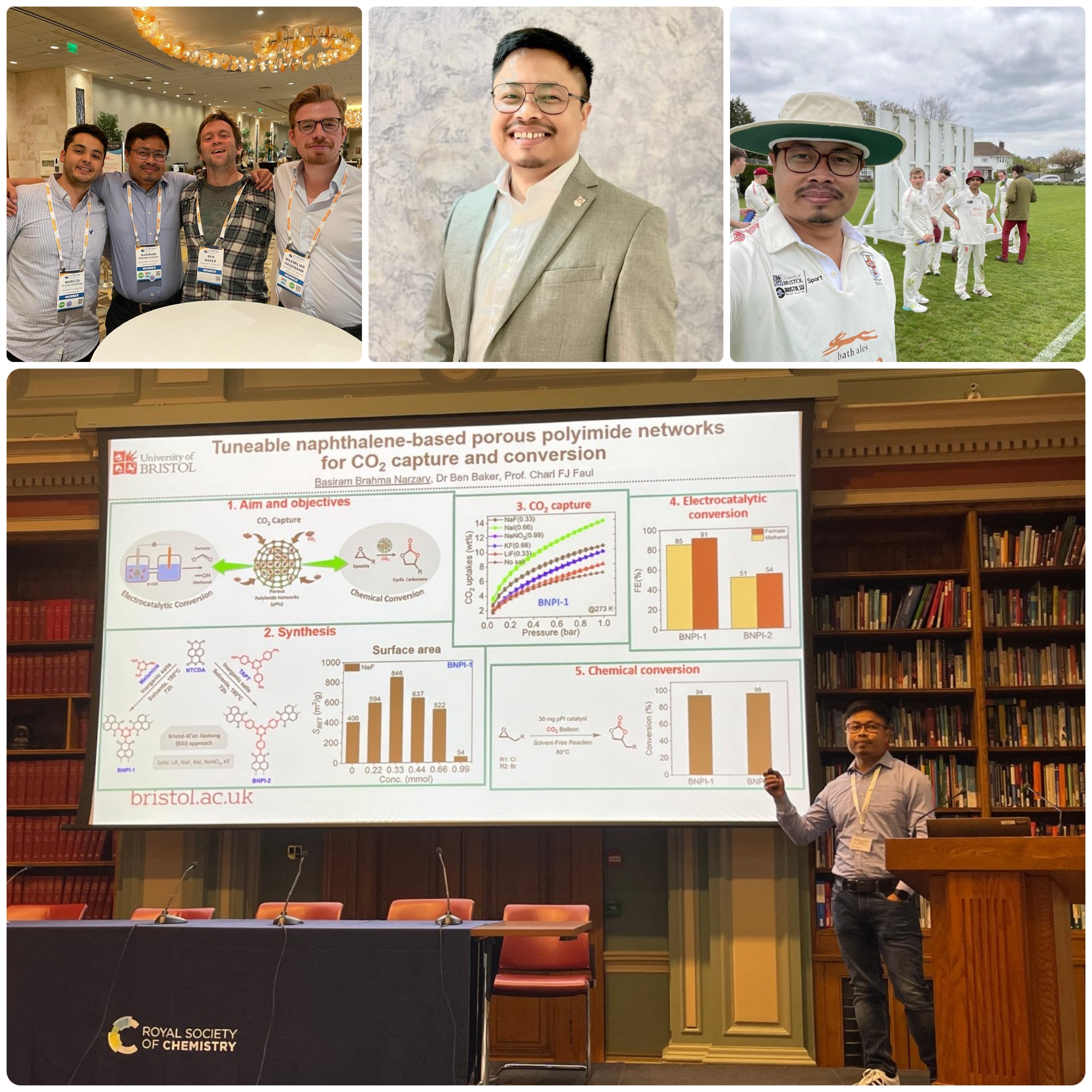
A massive congratulations to Basiram Brahma Narzary who passed his via on 17/10/2023 with minor corrections. With thanks to examiners Dr Sebastien Rochat and Prof. Arne Thomas for their time.
Work from Basiram’s PhD has been published as the following:
B.B. Narzary, B.C. Baker, N. Yadav, V. D’Elia, C.F.J. Faul, Crosslinked porous polyimides: structure, properties and applications, Polym. Chem. 12 (2021) 6494–6514. https://doi.org/10.1039/D1PY00997D.
B.B. Narzary, U. Karatayeva, J. Mintah, M. Villeda-Hernandez, C.F.J. Faul, Bifunctional metal-free porous polyimide networks for CO2 capture and conversion, Mater. Chem. Front. 7 (2023) 4473–4481. https://doi.org/10.1039/D3QM00639E.
Adéla Slavíková hails from her hometown of Tabor, Czech Republic. Her passion for sustainability and biomaterials led her to pursue a PhD under the guidance of Prof. Jiri Brozek at UCT Prague. Her research primarily revolves around the development, degradation, and application of polymers as biomaterials, with a specific focus on biodegradable polymers.
Adela joins the research group of Prof. Charl Faul as a visiting PhD student, undertaking a year-long internship as part of the emPOWER project. This collaborative experience promises to expand her knowledge and expertise in the field, allowing her to contribute to cutting-edge research and further her understanding of polymers’ diverse applications. Welcome.
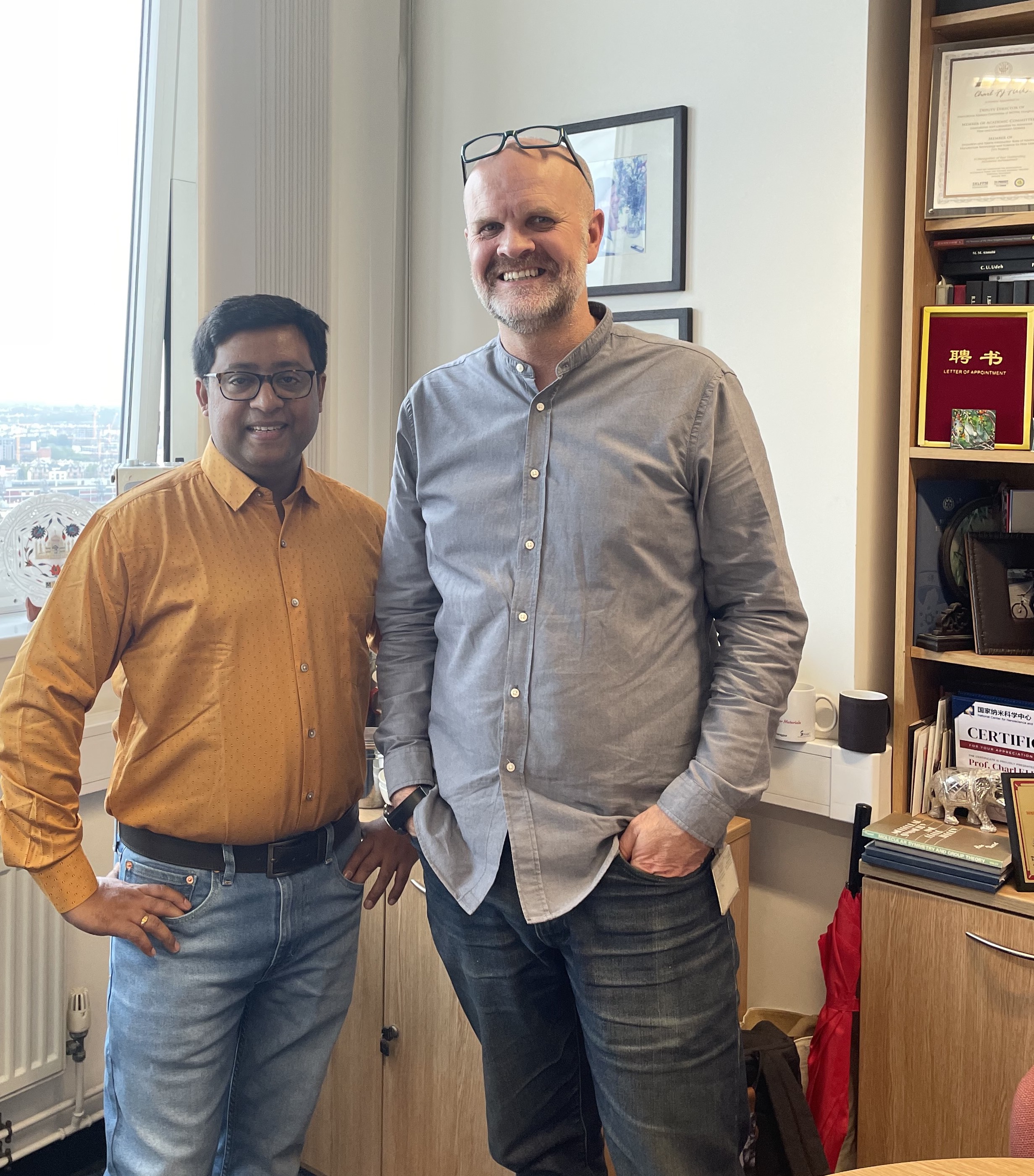
Based at the CSIR-Indian Institute of Chemical Technology, India, John’s research team is highly dedicated to engaging in the development, creation, analysis, and utilisation of catalytic porous materials. Specific focus is given to porous organic polymers (POPs) and metal organic frameworks (MOFs). Their primary goal is to transform both fossil fuels (crude oil and natural gas) and sustainable resources (such as biomass) into transportation fuels, chemicals, and materials. Additionally, their more recent focus lies in catalysing the conversion of carbon dioxide (CO2) and the separation of water (H2O) into hydrogen (H2) and oxygen (O2).
More details on Dr. Mondal’s visit and the next generation international research development happening between institutions can be found on Bristol’s web page here. Dr. Mondal’s personal home page can be found here.
Welcoming Dr. Mondal (left) on his research visit from the CSIR-Indian Institute of Chemical Technology.





 Faul Research Group