
Maxi’s work on a series of dopamine-based polymers and introduced as non-cytotoxic, single-component bio-adhesives that outperform commercial options features on the front cover of Macromol. Rapid Commun. See article 2400345 for more details.

Maxi’s work on a series of dopamine-based polymers and introduced as non-cytotoxic, single-component bio-adhesives that outperform commercial options features on the front cover of Macromol. Rapid Commun. See article 2400345 for more details.
A huge congratulations to Dr Safa Al Siyabi for successfully passing her PhD viva! Safa’s thesis focused on the synthesis of conjugated microporous polymers and their diverse applications in advancing sustainability.
With thanks to Anna Slater of the University of Liverpool and Sébastien Rochat of the University of Bristol for their expertise and time during the viva proceedings.
https://platform.twitter.com/widgets.jsA huge congratulations to Dr Safa Al Siyabi for successfully passing her PhD viva! With thanks to @AnnaGSlater of the University of Liverpool and @sebrochat of the University of Bristol for their expertise and time during the viva proceedings.
— Faul Research Group (@FaulResearch) December 3, 2024
Congratulations, Dr Fang!
https://platform.twitter.com/widgets.jsVery proud of @XueFang_Chem, co-supervised by @Charl_FJ_Faul, who passed her PhD viva today @BristolChem.
— Dr Natalie Fey (@NatalieFey_NLS) November 22, 2024
Thank you to @Buttsresearchgp and @a_logsdail for examining and @FaulResearch for letting us celebrate in their office space. pic.twitter.com/QCQgjCysJi
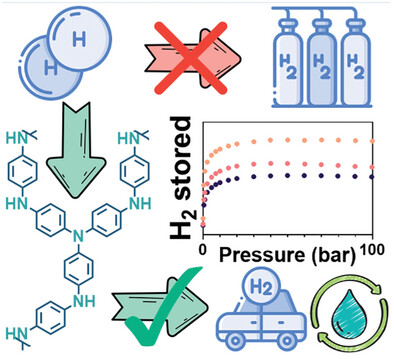
A recent paper titled “Polytriphenylamine Conjugated Microporous Polymers as Versatile Platforms for Tunable Hydrogen Storage” authored by John Worth and co-authored by Profs. Annela Seddon, Valeska Ting, and Charl Faul has been accepted for publication in Small by Wiley.
This work explores the use of polytriphenylamine-based conjugated microporous polymers (CMPs) for advanced hydrogen storage applications.
Article is now available in Early View: https://doi.org/10.1002/smll.202407292
Jerry Mintah has transitioned in and out of the Faul Group throughout his undergraduate chemistry degree at Bristol, contributing to a published study in a high-impact journal during this time. He now returns to pursue his PhD, focusing on the design and development of metal-free porous polymers for CO2 capture and conversion.
Welcome back, Jerry!
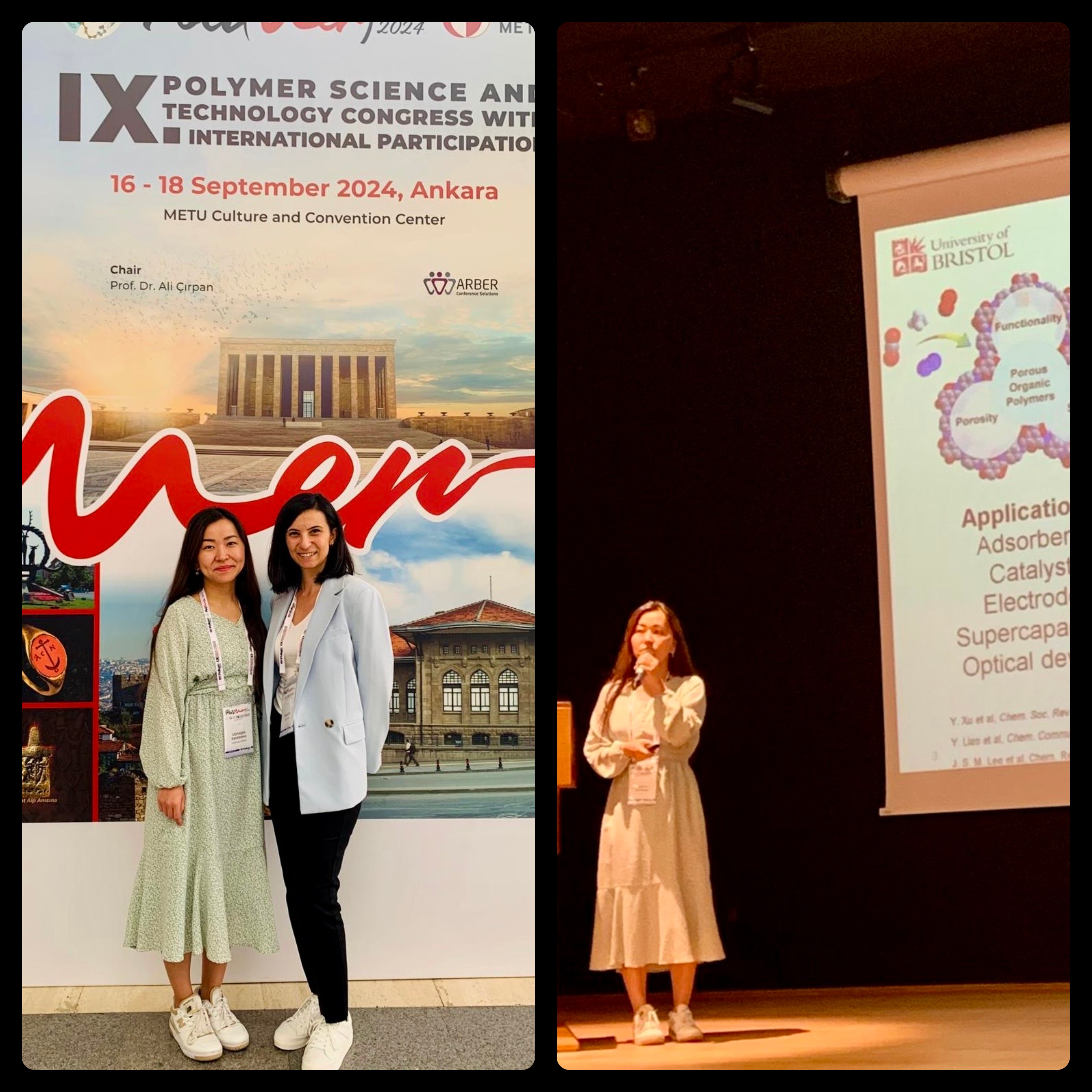
Last week, Ulia spoke and presented her research during the IX. Polymer Science and Technology Congress, organised biennially by the Polymer Science and Technology Association, at Middle East Technical University in Ankara.
This congress aims to unite top researchers, industry professionals, and students to discuss the latest advances in polymer science and technology, fostering collaboration and innovation.
During this month, Xue attended and presented at the data-driven discovery in the chemical sciences Faraday Discussion in Oxford, focused on the role of big data, machine learning, and artificial intelligence in various areas of chemistry. The event brought together researchers from both academic and industrial backgrounds.
Thanks for representing the group, Xue!

The undergraduates of 2024 (Ed Robinson, Tara Goldsworthy, Robin Fryar & Annabel Coekin) and Dr Sam Deeks celebrate their time within the Faul Research Group in July, 2024.
Congratulations, all.
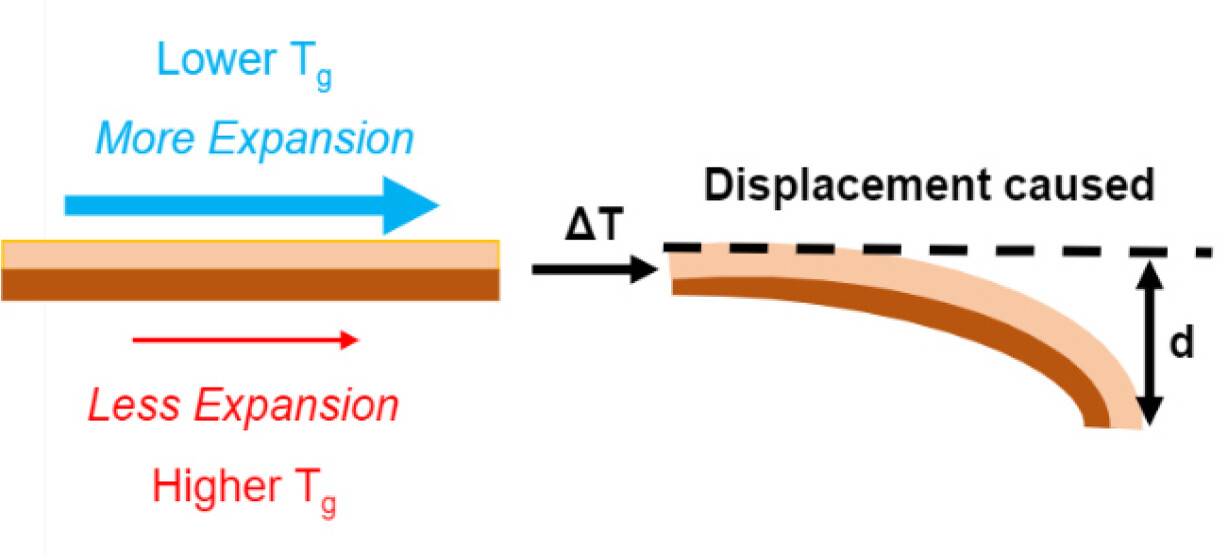
Pleased to announce that Dr. Baker’s article, in collaboration with former MSci student Leo Kershaw and visiting student Ziqui Yang, titled “Towards Implantable Artificial Muscles: Epoxy-Based Bilayer Thermal Actuators with Ambient Activation Temperatures,” is now available in ChemistrySelect.
The development of soft, biocompatible actuators is vital for soft robotics, especially for in vivo applications. This study presents epoxy-based materials for creating thermal actuators with tuneable glass transition temperatures (Tgs). By adjusting polymer compositions, actuators operating at physiological temperatures (36–40 °C) were achieved using both external heating and joule-heated NiChrome-epoxy systems. These actuators maintain safe surface temperatures below 40 °C at low voltages (<2 V). This promising approach could lead to implantable actuators improving the quality of life for the ageing population.
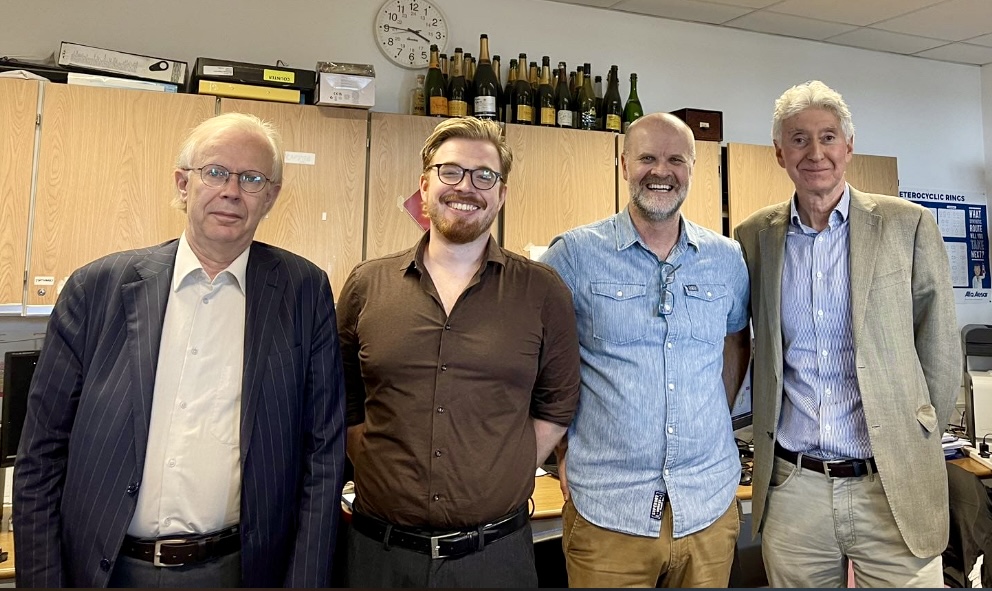
Congratulations to Dr Maximilian Hagemann who passed his PhD viva this afternoon. With thanks to Prof Stephen Mann of Bristol University and Prof Olli Ikkala of Aalto University for their time and expertise in the examination process. Photo below beautifully self-assembled in height order.
 Faul Research Group