Unknown's avatar

About Faul Research Group - Functional Polymers

This is the official website for the Faul Research Group, based in the School of Chemistry, University of Bristol, Bristol, UK. Follow us on LinkedIn: https://www.linkedin.com/in/charl-fj-faul-付强/

Charl and Yuanlei meet in … Shanghai!

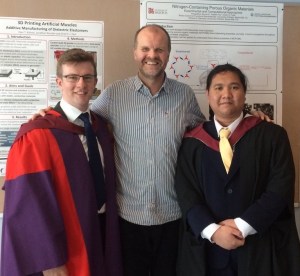
Yuanlei and Charl met up at the UoB’s China graduation ceremony, held, for the first time, in Shanghai! It was great to catch up with Yuanlei, who helped at the ceremony as volunteer. Yuanlei was also responsible for a for a great video of the event, which will be made public very soon!
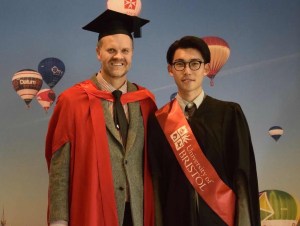
It was a fantastic afternoon and a great privilege to share in the day with many UoB graduates and their families!
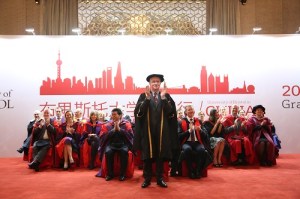
Well done and congratulations to those we graduated!
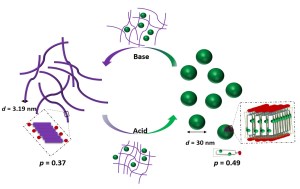
Wei’s paper accepted (and already appeared online) by Chemical Science!

A paper by Wei (who visited the Faul Research Group as a CSC visitor for one year), Maha, Alex, Kazu, Ben and other collaborators was just accepted for publication by Chemical Science!

The paper shows, for the first time, the ability to reversibly tune the packing parameter of amphiphiles (the packing parameter is a concept that has been used for many decades to predict the structures amphiphiles will form on self-assembly). We here show that it is possible to tune the tail volume of our electroactive amphiphile through non-covalent interactions (i.e., doping of the tetra(aniline)-containing tail!), providing a route to tune self-assembled structures reversibly between fibers and vesicle-like objects.

As the paper is available freely as an open-access publication, feel free to download and read “An addressable packing parameter approach for reversibly tuning the assembly of oligo(aniline)-based supra-amphiphiles“.  Well done Wei and team!

Dicker’s 2017 Scientific Reports publication a “Top 100” paper!

Congratulations to Dicker, who’s 2017 paper in Scientific Reports was recently selected as a “Top 100 accessed chemistry article“!

The open access paper, entitled, “Light-Triggered Soft Artificial Muscles: Molecular-Level Amplification of Actuation Control Signals” discussed a biomimetic molecular-level approach that employed light, with its excellent spatial and temporal control properties, to actuate soft, pH-responsive hydrogel artificial muscles. Although this actuation is triggered by light, it is largely powered by the resulting excitation and runaway chemical reaction of a light-sensitive acid autocatalytic solution in which the actuator is immersed. This process produced actuation strains of up to 45% and a three-fold chemical amplification of the controlling light-trigger, realising a new strategy for the creation of highly functional soft actuating systems.

Scientific Reports published more than 5000 chemistry papers in 2017 – outstanding achievement, well done Dicker!


Goodbye (kind of!) to the project students!

As the academic year rushes along, it was that time of the year again – the final year undergraduate research project students gave their presentations recently (after some delays due to the bad weather).

As is the tradition, we said “well done” and “goodbye” by going to Cosmo for a great  all-you-can-eat lunch!


Superb viva from Dr Charlie!

Charlie (jointly supervised by close collaborator Ian Manners and Charl) defended his thesis earlier this week, with Prof Gustavo Fernandez from Muenster acting as external examiner.  Charlie did a superb job, and will be wrapping up his minor corrections soon!

In addition to the viva, we also enjoyed an afternoon of student talks (with Maha from the FRG giving a great talk!), with Gustavo ending off the afternoon of exciting science with some of the detailed mechanistic work on supramolecular self-assembly from his laboratories.


Friends and visitors, and new group members!

We have had the privilege to have had both Wei and Ben (former PhD students) visiting during the last week! Was great to have both of them here, at the same time!

A new postdoc, Pan, also joined the group in the last week! Pan, who did his PhD at the National Centre for Nanoscience and Technology in Beijing (with Prof Bao-Hang Han), was awarded a Newton International Fellowship for 2 years! Welcome Pan!


New year … and new publication!

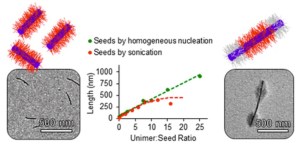
A paper, with authors from the Manners and Faul group, just appeared in Macromolecules. Liam, who is a joint PhD student between the two groups, contributed to the paper where the formation of uniform block copolymer fiberlike micelles of controlled length with a crystalline polyselenophene core was explored. Careful control of preparation conditions, especially choice of solvent for the self-assembly, led to the formation of very long fiberlike micelles (of up to 900 nm).

See the paper here for further details.  Well done to Emily, Ali and Liam!


Maha and Charl in London

Maha and Charl attended the “McBain Medal 2017: Watching Colloids Work” meeting in London recently.  Former Bristol student and good friend of the FRG, Dr Rico Tabor (from Monash University in Melbourne) was presented with the McBain medal of the Society of Chemical Industry. As part of the one-day symposium Maha presented a poster on some of her recent work on bola-amphipihles, while Charl gave an invited talk.

Great symposium, and a fantastic opportunity to meet many of the FRG’s collaborators!

Busy Christmas season!

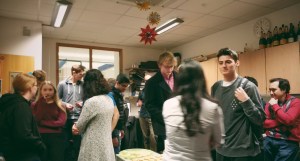
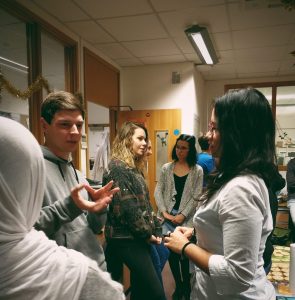
The busy Christmas season has kicked off with a first “Mince Pie Mixer” of all of Charl’s undergraduate personal tutees and the whole Faul Research Group. This was a great event to get to know each other better, but also to exchange some tips around potential routes to further studies and employment.

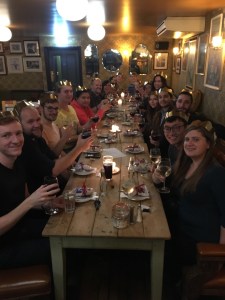
This event was followed earlier this week by the FRG’s Christmas Party. It was, for the first time since Charl and Jacqueline’s arrival in Bristol, not held at their home, but at the very nice Grupo Lounge in Westbury-on-Trym! The food was great, Secret Santa presents exchanged, and generally a fantastic evening!