
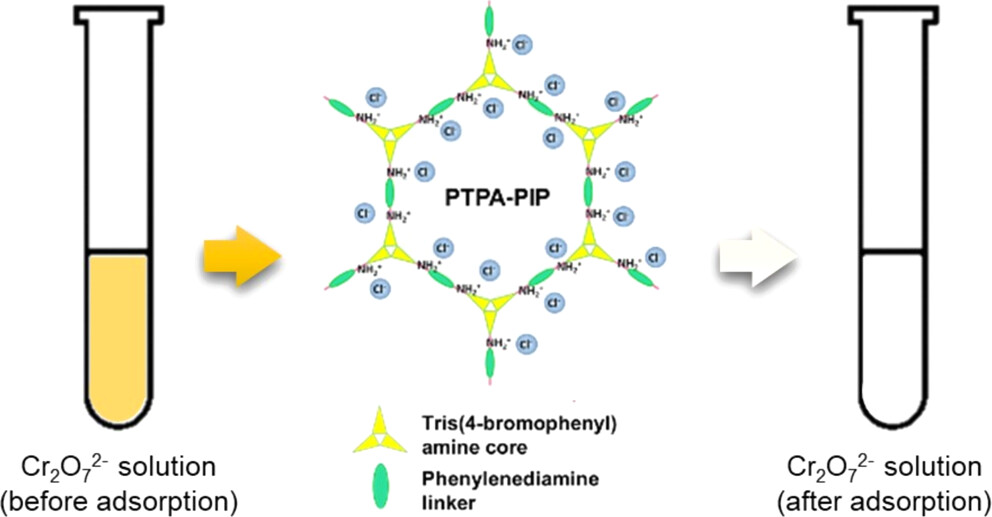
Efficiently treating wastewater contaminated with carcinogenic hexavalent chromium (Cr(VI)) has been a persistent challenge in both academic and industrial research. While ion exchange is recognised for its simplicity and effectiveness, its integration with advanced nanomaterials offers enhanced potential. The cationic porous organic polymer (POP) PTPA–PIP is a novel development poised to aid in industrial wastewater treatment.
PTPA–PIP is synthesised by converting the aromatic polyamine PTPA into its protonated form. This modification significantly increases the polymer’s hydrophilicity, enabling it to disperse uniformly in aqueous environments, which is essential for efficient water treatment applications. PTPA–PIP demonstrates the following:
High exchange capacity: PTPA–PIP exhibits a maximum adsorption capacity of 230 mg Cr2O72– per gram of polymer.
Rapid adsorption kinetics: It achieves an initial adsorption rate of 83 mg g–1 min–1, indicating ultrafast removal of contaminants.
Exceptional Selectivity: The polymer retains approximately 90% of its adsorption capacity even in the presence of a 40-fold concentration of competing anions.
Robust reusability: PTPA–PIP can be reused for at least five cycles without significant loss of performance.
This publication documents a substantial advancement in the field of wastewater treatment with porous polymers, offering a highly effective solution for addressing the challenges associated with Cr(VI) contamination.
The article can be found at the following link.

 Faul Research Group