Paper now published!

Ulia’s collaborative paper with Prof Ozlem Errol has now been published in ACS Applied Polymer Materials. Click here for the paper, published Open Access and available for free download!

Electrorheological fluids (ER) make up a class of smart materials that are distinguished by their capacity to alter their rheological characteristics in a controlled and reversible manner in response to an externally applied electric field (E). Three-dimensional (3D) conjugated microporous polymer (CMP) analogs of PAni have a nitrogen-rich porous and hierarchical structure, low density, and appropriate conductivity that can be used to explore ER performance and dispersion stability. Here, a carboxylic acid functionalized version was designed to obtain higher polarizability and appropriate conductivity without the need for a dedoping process and thus enhanced ER performance.
Paper accepted in ACS Appl. Polym. Mater.!

A recent paper titled “Electrorheological Fluids Based on Porous Carboxyl-Functionalized Polytriphenylamines” authored by both Ulzhalgas Karatayeva and former postdoc Dr Ozlem Erol (now assistant professor at Gazi University, Ankara, Türkiye), and Charl Faul has been accepted for publication in ACS Appl. Polym. Mater.

Further information and more details to follow soon!

Christmas!

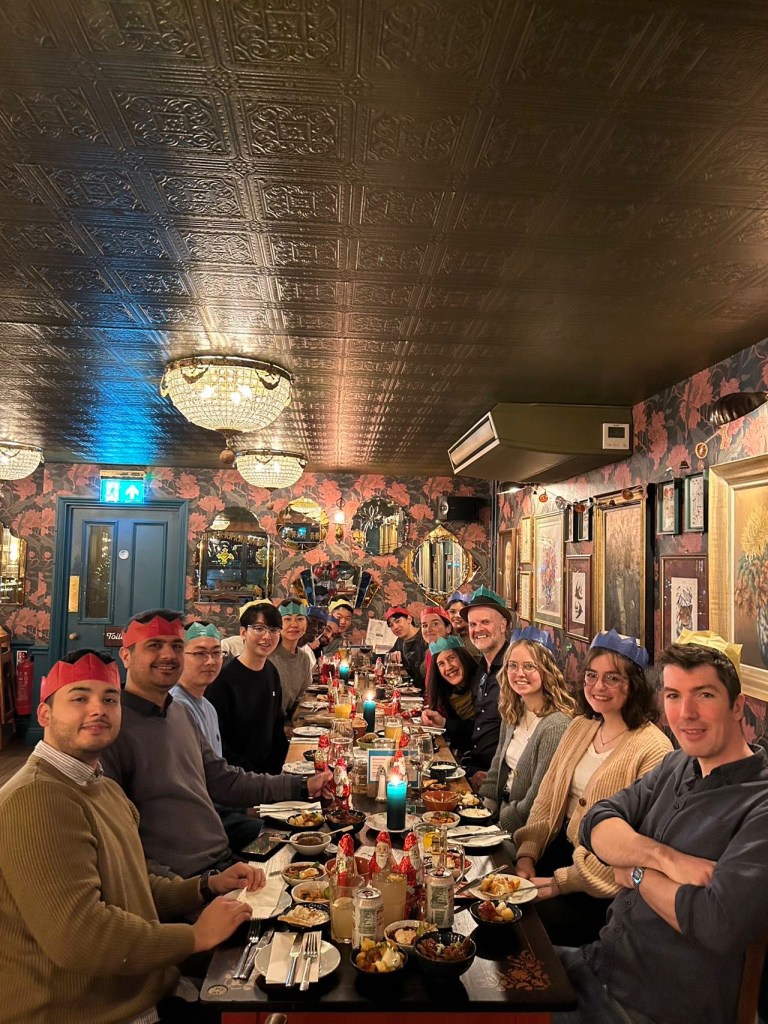
The end of 2024 and Christmas are just around the corner! During this busy Christmas season, we bid heartfelt farewells to many team members, while also joyfully welcoming several new faces this year!

Of course, we couldn’t miss our annual Christmas party, this year at the lovely Grupo Lounge in Westbury-on-Trym! With delicious food, Secret Santa exchange, and lively Crimbo Bingo, we enjoyed a fantastic and unforgettable evening! 

Wishing all a Merry Christmas and a wonderful New Year ahead!

New paper in Advanced Materials!

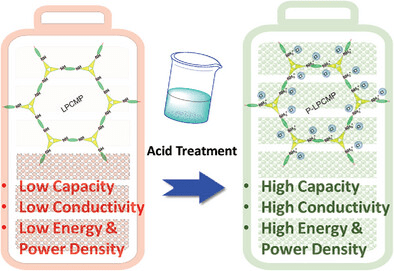
A new manuscript Triphenylamine-Based Conjugated Microporous Polymers as the Next Generation Organic Cathode Materials is now available online in Advanced Materials Early View.

Here, a novel triphenylamine-based porous polymer (LPCMP) is presented as an outstanding lithium-ion battery cathode, delivering 146 mAh g-1 at 3.6 V, high power density, and stability over 1000 cycles, marking a breakthrough for high-energy organic LIBs. These exciting results stem from the close collaboration with colleagues from the National Centre for Nanoscience and Technology, Chinese Academy of Sciences, Beijing.

Safa Al Siyabi completes her PhD!

A huge congratulations to Dr Safa Al Siyabi for successfully passing her PhD viva! Safa’s thesis focused on the synthesis of conjugated microporous polymers and their diverse applications in advancing sustainability.

With thanks to Anna Slater of the University of Liverpool and Sébastien Rochat of the University of Bristol for their expertise and time during the viva proceedings.

https://platform.twitter.com/widgets.js

Xue passes her viva!

Congratulations, Dr Fang!

https://platform.twitter.com/widgets.js

Paper accepted in Small

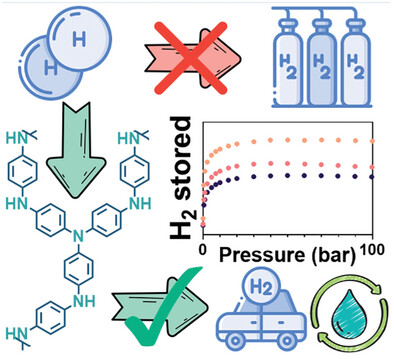
A recent paper titled “Polytriphenylamine Conjugated Microporous Polymers as Versatile Platforms for Tunable Hydrogen Storage” authored by John Worth and co-authored by Profs. Annela Seddon, Valeska Ting, and Charl Faul has been accepted for publication in Small by Wiley.

This work explores the use of polytriphenylamine-based conjugated microporous polymers (CMPs) for advanced hydrogen storage applications.

Article is now available in Early View: https://doi.org/10.1002/smll.202407292