The paper with Shao (now doing a post-doc in Sweden), Saravanan, and other collaborators (from Glasgow and Beijing!) has appeared on the front cover of the Journal of Materials Chemistry! Well done!
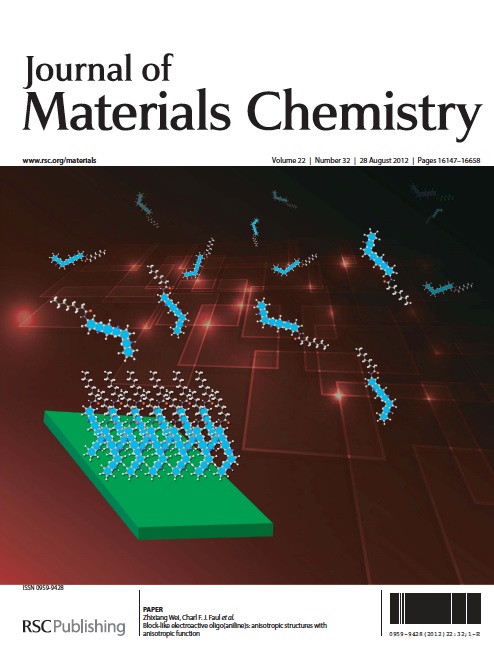
The paper with Shao (now doing a post-doc in Sweden), Saravanan, and other collaborators (from Glasgow and Beijing!) has appeared on the front cover of the Journal of Materials Chemistry! Well done!
The FRG went to the Grain Barge (on the harbourside, Hotwells, looking out over the SS Great Britian) after the usual Monday afternoon group meeting to celebrate the recent anouncement that Charl has been promoted to the position of “Reader in Materials Chemistry”. It was a fantastic sunny afternoon in a great setting – the perfect place to celebrate!
Huaping Xu, and a PhD student Kai Liu, from the Department of Chemistry, Tsinghua University, Beijiing, visited Bristol from Saturday – Tuesday. After an interesting day of scientific discussions, Huaping gave an excellent talk entitled: “Selenium-containing Polymers: from Molecular Design to Controlled Self-assembly and Disassembly.” We then all rewarded ourselves by going to the Robin Hood on St. Michael’s Hill!
See the link on the University of Bristol’s Weibo pages!
My recent Soft Matter paper has been highlighted in the Diamond Light Source Annual review. Diamond is a synchrotron radiation facility near Oxford, UK that generates intense beams of radiation (from hard X-rays through to infra-red). The annual review contains highlights of research performed across the synchrotron over the past year. The report demonstrates the broad range of science currently undertaken at the facility including magnetic resonance imaging as a tool for understanding Alzheimer’s disease, structural analysis of influenza antibodies and my surface diffraction studies of conducting organic thin films. See the following link for the review:
http://extranet2.diamond.ac.uk/ISV/Flipping/files/DiamondReview2012.pdf
The latest paper from the FRG, in collaboration with the group of Zhixiang Wei at the CAS National Centre for Nanoscience and Technology, Beijing, just appeared online in the Journal of Materials Chemistry.

A tetra(aniline)-alkyl diblock compound was designed, synthesized and fully characterized. By employing suitable conditions, doped, electroactive microstructures could be prepared. The microstructures were characterized in detail and their anisotropic conductivity measured for the first time.
Congratulations to Shao (now in Sweden), Saravanan and other authors! This has now also appeared on the University of Bristol’s Weibo pages in China!
This week I have been in Baltimore, MD (USA) for the 86th Annual Colloids and Surface Science Symposium. The meeting was held at Johns Hopkins University, a beautiful, leafy campus with grand red brick and marble halls.
The conference was organised over 3 days and featured 7 parallel sessions each day in addition to a variety of plenary and award lectures. The science was fascinating, with topics covering the fundamentals of the hydrophobic interaction, micro-scale self-folding origami structures, and biological and environmental applications. I presented my talk, “Oligo(aniline) nanofilms via ionic self-assembly”, on the 2nd day within the Molecular Assembly section, which also featured talks on poly(electrolyte)-surfactant complexation and other surface self-assembly.
The conference banquet was held on the evening of the second day at the Baltimore Museum of Industry. Highlights of the food on offer were the local specialties of crab cakes and steamed crab!
Check out the picture gallery for some shots of Johns Hopkins University, me presenting and the conference banquet at the Baltimore Museum of Industry.
A new study on chiral self-assembled sugar-substituted perylenes with Zhixiang Wei’s group was accepted and published online in Advanced Functional Materials today!

It was shown that supramolecular structures and helicity of this new perylene derivative can be tuned by kinetic and thermodynamic factors. Demonstration devices for hydrazine sensing based on single nanoribbons exhibit better performance than nanofiber bundles and other achiral nanostructure devices. This provides a pathway to tuning the structures and helicity as well as the possibility to construct high-performance nanodevices.
Natalie Stingelin, from the Department of Materials and Centre for Plastic Electronics, visited the FRG labs and the BCFN yesterday. She gave an excellent talk on manipulating phase transformations and order of organic semi-conductors in the solid state. It was a pleasure to have her here, and we look forward to continued contact in the future!
As we are entering into the summer grant writing season, I thought it good to highlight an upcoming opportunity to join the FRG. These might not be suitable in all cases to all candidates, so please read carefully:
If you have >10 publications and patents, and are not based in the UK, it might be possible to apply for a prestigious EU Marie Curie Fellowship. There are a number of schemes, including International Incoming Fellowships (for researchers based outside the EU) and Intra-European Fellowships (if you have spent at least the last 18 months within the EU, irrespective of your nationality). Please only contact me if are over the threshold of 10 publications. Internal deadline for submissions of applications the 9th of August 2012, so please contact me as soon as possible if you think you are eligible.
-charl-
Carl and Charl ran the Bristol 10k race on Sunday, the 20th of May. They both finished the race under 1h! Here a photo of the two of them – Charl is looking tired and angry, Carl is looking happy and full of energy!
 Faul Research Group