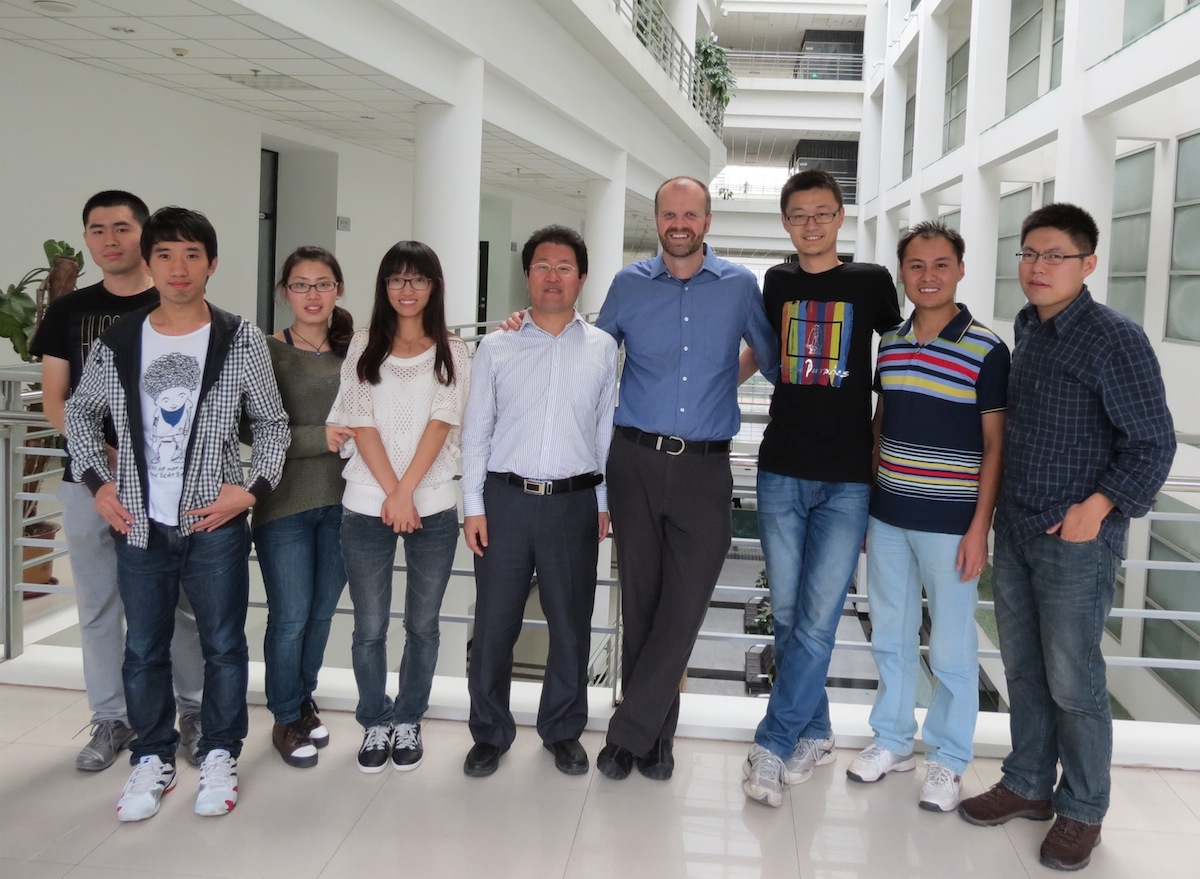
It was recently announced that Charl has taken up an adjunct professorship at the Department of Chemistry at Tsinghua University, Beijing, China. This 3-year position will certainly contribute to strengthen the ties between Bristol and Tsinghua!
Category Archives: Collaborations
Paper in Chemical Science with our collaborators from Tsinghua University!
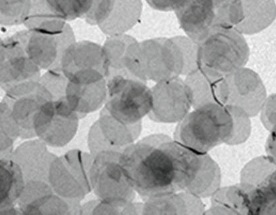
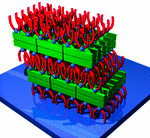
Charl contributed to a paper with our collaborators, Prof Acad Xi Zhang and his group, at Tsinghua University in Beijing, China, investigating the self-assembled structures of bolaamphiphiles.
The study, exploring a facile counterion-directed structure switch from 0D/1D to 2D planar structures by a simple counterion exchange to tosylate ions, appeared online in Chemical Science recently. More to follow soon!
James, Charl and others from the BCFN in China!
A large group from the Bristol Centre for Functional Nanomaterials, including James (joint PhD student with Heinrich Hoerber) and Charl are currently in Beijing, China. They participated in a joint symposium on Tuesday with the CAS National Centre for Nanoscience and Technology on Monday (see the photo below), and are currently attending the ChinaNANO’13 conference.
On Monday they will visit our collaborators at the Department of Chemistry at Tsinghua University for the “1st Tsinghua-Bristol Joint Nanoscience Symposium”
Chinwe’s paper online!
Chinwe’s paper (with James, Ben and Patrice, our collaborator from Grenoble) on tuning conductivity and structure of tetra(aniline)-based triblock structures appeared online on the Journal of Materials Chemistry C’s website!
In this paper we reported on our investigations into the aggregation behaviour and optoelectronic properties of these π-conjugated rod–coil–rod triblock materials. Well done!
Charl at the College of Chemistry, Jilin University, Changchun
Charl arrived in Changchun on Wednesday afternoon, and started with a full day of lectures on Thursday, covering the topics of scientific misconduct and scientific writing in two 2h lectures! More than 300 graduate students attended the lectures, and extra chairs were brought into the lecture hall!
Here he can be seen relaxing with Prof Junqi Sun (vice-dean of the College of Chemistry, who invited Charl) and some of his research group members after his lectures.
Chinwe’s paper accepted!
A paper by Chinwe on the assembly and control of TANI triblock structures, and two order-of-magnitude tuning of conductivity was just accepted for publication in the Journal of Materials Chemistry C! This paper further strengthens the cooperation the FRG has with Dr Patrice Rannou (Grenoble), who is one of the co-authors. More details to follow soon, but in the meantime – well done to all involved!
Tom’s paper online @ Soft Matter
Tom’s paper, a collaborative efforts between the Briscoe and Faul research groups, appeared online at Soft Matter today!
The study, entitled “Oligo(aniline) nanofilms: from molecular architecture to microstructure” demonstrates that through a simple processing route the morphology of electroactive oligomer films can be tailored by molecular design. These findings from detailed GIXS studies are important to future applications where thin film structure is a crucial consideration for device function and performance. Congrats to Tom and all other colleagues involved!
Tom’s paper accepted for publication in Soft Matter!
A detailed structural study by Tom of oligo(aniline) thin films using grazing incidence X-ray scattering has been accepted for publication in Soft Matter. This was a joint effort between the Faul and Briscoe research groups and other collaborators. More details to follow!
Tom’s contribution to a new paper from the Briscoe group
Tom contributed to a paper from the Briscoe group investigating the formation and structure of surfactant bilayers at the mica-water interface. This detailed study was recently accepted for publication in Soft Matter!
Congrats to Tom, Wuge and other contributors!
Charl in the US
Charl is on a short trip to the US, visiting DuPont as part of the SoC’s Year in Industry undergrad programme, as well as the Institute of Molecular Engineering at the University of Chicago to give a seminar.