Well done to Marcos – graduating today to receive his BCFN MSc in Nanoscience and Functional Nanomaterials!
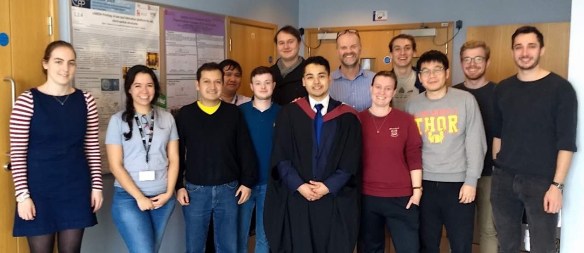
And great to have him on board as a joint PhD student between the Dicker and Faul research groups! Well done Marcos!


Well done to Marcos – graduating today to receive his BCFN MSc in Nanoscience and Functional Nanomaterials!
And great to have him on board as a joint PhD student between the Dicker and Faul research groups! Well done Marcos!
Esther is currently visiting collaborator and good friend Rico Tabor‘s group at Monash University (in Melbourne, Australia!). Here she is with Rico, Luke (co-supervised by Charl) and other members of Rico’s group!
She also used this opportunity to attend and give a talk at the 9th biennial Australian Colloid and Interface Symposium, which was held in Hobart, Tasmania. Enjoy!
Prof Hiroshi Kitagawa (Department of Chemistry, Kyoto University) spent two days with the Faul Research Group. It was a pleasure to have a world-leading scientist interacting with many in the group (and enjoying some of the group’s local activities!).

Prof Kitagawa gave a fantastic talk on his “Conductive Coordination Networks“, showcasing some of the very detailed studies on his various porous metal-containing MOF architectures. Very impressive!
The new round of the Newton International Fellowship funding scheme has just been announced by the Royal Society! This scheme is for those interested in applying for a position as a post-doctoral researcher in the UK; specifically, for non-UK scientists who are at an early stage of their research career and wish to conduct research in the UK! Click on this link for the detailed scheme notes.
If you are interested to apply for a position in the Faul Research Group, please email Prof. Faul with your CV and TWO letters of reference by the 28th of February.

Charl was invited to join the International Advisory Committee for Donghua University‘s State Key Laboratory for Fibers and Polymer Materials in Shanghai. It was a great opportunity to have a fantastic overview of the science done in this exciting area, but also to meet friends and colleagues from China, the USA, Europe, Singapore and Africa!

It was also a great opportunity to catch up with former postdoc (and now professor at Donghua), Yaozu Liao, and to meet a fellow African, Dr Samuel Chigome from the Botswana Institute for Technology Research and Innovation (BITRI)!


Happy 2019! The year has started on a high note, with our first paper (joint with our collaborators Jiangfei Xu and Xi Zhang from the Department of Chemistry at Tsinghua) just accepted and appeared online in Chemistry Society Reviews!

Henry and Charl contributed to the tutorial review, entitled “Molecular Engineering of Polymeric Supra-amphiphiles“, where the concept of supra-amphiphiles is introduced and discussed in detail! Well done to all involved!
 2018 is almost over, so all that is left to do at this stage is to thank all our collaborators, colleagues and friends (and visitors to our website!) for a great year! We wish you all a peaceful Christmas, and all the best for 2019!
Djen’s paper appeared online today on the Advanced Materials Technologies website!
A major challenge for soft electroactive devices such as dielectric elastomers is the fabrication of thin, precisely patterned, stretchable conductors. In this work, laser‐scribed graphene oxide is used to fabricate intricate, stretchable electrodes for dielectric elastomer actuators.

The method is simple, low‐cost, and green (free of organic solvents) and produces arbitrary geometries with 0.1 mm resolution.
It has been a great week for publications! Ben’s paper was recently accepted, and just appeared earlier today on the MSDE (Molecular Systems Design & Engineering) website! This study, entitled “Tipping the polaron–bipolaron balance: concentration and spin effects in doped oligo(aniline)s observed by UV-vis-NIR and TD DFT” is an invited contribution to the special themed collection “Soft Materials Nanoarchitectonics”.
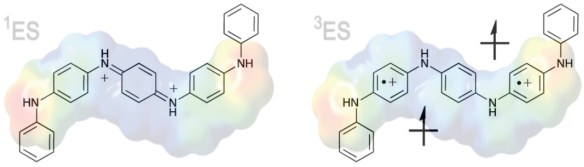
We describe a robust computational protocol for modelling the molecular geometries, electronic structures and absorption spectra of oligomers of the widely-used and versatile conducting polymer, poly(aniline). By comparing experimental UV-vis-NIR and EPR spectra with TD-DFT simulations, we discovered it is possible to switch reversibly between diamagnetic and paramagnetic forms (bipolaronic and polaronic states) of oligo(aniline)s in solution simply by adjusting dopant concentrations – a finding which could reinvigorate research into conduction mechanisms in poly(aniline) and related materials, as well as allowing control of material properties and functionality.
Well done Ben, Shao, Steph, and collaborators Dave, Patrice and Natalie!
Great news – Djen’s paper on “Laser-scribed Graphene Oxide Electrodes for Soft Electroactive Devices” has been accepted for publication by Advanced Materials Technologies.

Here we (Djen, Jonathan Rossiter and Charl) show that laser-scribed graphene oxide (LSGO) can be used to fabricate patterned, stretchable electrodes for dielectric actuators (DEAs) – even an actuating University of Bristol logo!
Well done Djen!
 Faul Research Group